
Billboard Africa, Rolling Stone Africa, and the Question African Creators Can No Longer Avoid
For months now, industry conversations across the continent have returned to the same concern.
Artists mention it privately. Label managers hint at it during conferences. Cultural operators discuss it off the record.
Everyone sees the same pattern, but few are willing to say it publicly.
Global media giants are entering Africa.
That is a milestone worth acknowledging.
But the way they choose to cover “Africa” is raising important questions about representation, honesty, and responsibility.
It’s time to voice what has quietly been circulating in our industry circles respectfully, clearly, and without fear.
Billboard Africa: A Continental Name With a Regional Focus
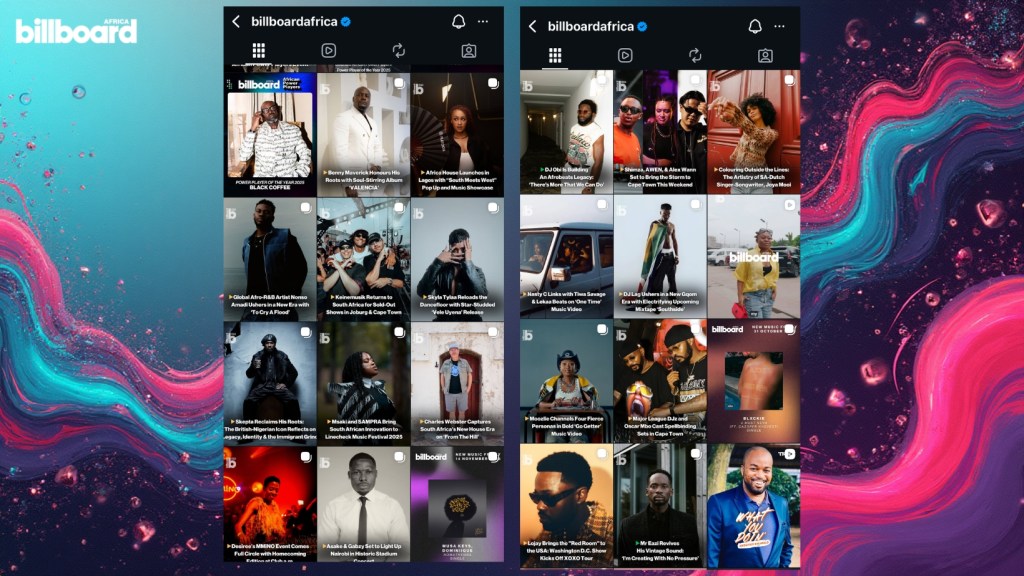
When Billboard launched its African edition, optimism was high.
The brand carries global weight: charts, data transparency, editorial authority. Many expected a platform capable of documenting Africa’s cultural complexity with depth and nuance.
Instead, its early editorial output has been overwhelmingly concentrated on:
- South African entertainment
- Amapiano news
- Anglophone West African updates already widely covered elsewhere
Entire regions stay barely visible. These include not only Central Africa and the francophone and lusophone blocs, but also much of East and Southern Africa. Many countries rarely are on the editorial map. These countries include Burundi, Rwanda, Eritrea, Lesotho, Botswana, Eswatini, and the Comoros. There are also overlooked pockets in Ethiopia, Mozambique, and Tanzania. Nonetheless, these areas have vibrant cultural ecosystems.
This raises a difficult but necessary question: are these gaps logistical, or simply commercial?
Many of these regions don’t fit the high-visibility genres driving Africa’s global exports. If media outlets privilege what is easy to market or monetize, quieter or genre-specific communities inevitably disappear from view. Not for lack of value, but because they lack commercial simplicity.
Representation is not only about who gets featured, it determines who gets documented, remembered, and ultimately included in Africa’s cultural record…
Rolling Stone Africa: More Inclusive, But Still Too Cautious
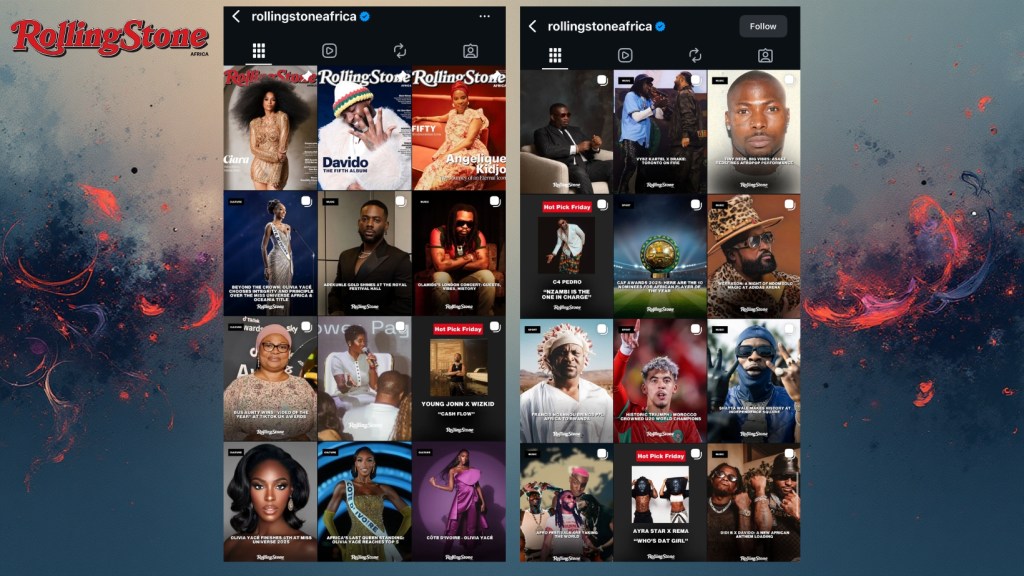
To be fair, Rolling Stone Africa has shown a broader editorial curiosity than Billboard Africa so far.
They have covered cultural updates and music stories from:
- francophone spaces,
- Lusophone artists,
- emerging scenes outside the usual Nigeria–South Africa axis.
This effort deserves recognition.
However, the approach remains timid, occasional inclusivity rather than systematic coverage.
Rolling Stone Africa’s challenge is similar:
A continental brand is working with regional resources. It is trying to speak broadly while operating from a narrow operational base.
The result is better balance than Billboard Africa, but still far from a truly pan-African media ecosystem.
Why These Gaps Matter
Representation isn’t just about who gets featured — it determines which stories become part of Africa’s cultural landscape. This concern isn’t new. As one regional analysis noted:
“African journalists are increasingly criticized for echoing Western stories while neglecting key developments unfolding in neighboring African countries.”
— Africa Journalism and Excellence Network
And early reactions to Billboard Africa cautioned that:
“By attempting to reflect the continent as one market, it risks privileging those already visible.”
— The Nollywood Reporter
The issue is straightforward. When platforms present themselves as continental but concentrate on a few dominant hubs, entire regions fall outside the frame. What goes unreported struggles to gain recognition or historical weight.
This is more than an editorial preference. It shapes who has the authority to describe Africa, whose work receives long-term value, and whose voices are pushed aside. When coverage remains anchored in anglophone centers, many communities lose visibility and influence.
In media, absence has real consequences. It distorts how culture is perceived and remembered. Africa’s scale and complexity demand coverage that reaches beyond convenience or familiarity.
The Silence Within the Industry

So why has no one said this openly until now?
Because criticizing global brands carries a risk.
These platforms offer visibility, and very few want to appear confrontational or ungrateful.
So conversations stay discreet, whispered at festivals, exchanged in private chats, softened during panel discussions.
At Lisoro Magazine, we are conscious of our own position.
We are a small publication operating from Central Africa — a region historically underrepresented in continental media.
We are not neutral observers; we want broader inclusion. We say so plainly.
But acknowledging that bias does not negate the reality we are addressing.
Professionals across the continent have privately voiced their frustration about the imbalance. This includes individuals in Nigeria and South Africa. These regions benefit from the most consistent coverage.
And as modest as our platform is, we work every day to contribute differently.
We stay committed to questioning narratives that deserve scrutiny.
For us, responsible African journalism means:
- prioritizing deep research,
- verifying sources rigorously,
- offering perspective rather than noise,
- and pushing for uplifting, constructive storytelling even when the topics are uncomfortable.
We also acknowledge something essential. No one is immune to mistakes. This includes the large platforms, the small ones, and certainly us.
Progress relies on our ability to learn from those errors. These can be past, current, or future mistakes. We must continuously refine how we tell stories about our continent.
Setting new standards means accepting our imperfections while striving every day to do better.
This responsibility does not belong to Lisoro alone.
It belongs to every African cultural actor who believes that narratives shape identity. Honest journalism is also essential to protecting our stories.
What True Continental Coverage Requires
If Billboard Africa, Rolling Stone Africa, or any incoming global platform intends to speak for the continent, a few fundamentals are non-negotiable:
Transparency about scope: if coverage is regional, say it; if it’s continental, resource it as such.
Local reporting across regions: not just the usual hubs.
Multilingual coverage: English is a practical bridge. Still, it can’t, on its own, represent Africa’s full linguistic and cultural spectrum.
Documentation that goes beyond trends: capturing heritage and community scenes.
Collaboration with African publications: to strengthen context and accuracy.
Africa’s Story Deserves Integrity
The presence of international brands in African media can be positive. Yet, the work must match the promise. Real continental coverage requires intention, curiosity and accountability.
Africa can’t be reduced to a handful of markets or genres. It needs a media ecosystem willing to do the work, go deeper, and widen the frame.


 LISORO MAGAZINE