

From July 30 to August 2, 2025, Bangui became the center of attention. This occurred for a few days. This attention came from Africa and even the world. For the first time, a Central African country hosted the African Caucus of the IMF and World Bank. This is the annual gathering. It brings together finance ministers, central bank governors, heads of financial institutions, and leading figures in development. Among them are Christine Lagarde, the current President of the European Central Bank. Also present is Tony Elumelu, Chairman of the UBA Group and a champion of African entrepreneurship.
Bangui is not yet Johannesburg or Marrakech. Yet, despite limited infrastructure, a modest hotel capacity, and real logistical challenges, the capital rose to the occasion. For a brief moment, the city center adorned itself with event colors. Streets were cleaned, banners were placed at major intersections, and security forces were visible. Hotels reached full capacity. Restaurants and artisans benefited from the presence of rare, high-profile visitors. For the Central African Republic (CAR), this was more than a ceremonial welcome. It was a powerful political gesture. It was a demonstration of capability and resilience.
What Bangui Gained
On the institutional front, the Caucus offered an unprecedented moment of learning and visibility:
- Proof that Bangui can host high-level leaders and hold multi-day discussions without incident.
- A real-life test of international standards in protocol, logistics, and inter-institutional coordination.
- Strengthened channels of dialogue with development partners and multilateral institutions.
Economically, a signal was sent. President Faustin-Archange Touadéra lobbied Tony Elumelu. He advocated for the opening of a United Bank for Africa (UBA) branch in CAR. The goal: to give small and medium-sized enterprises (SMEs) which represent about 80% of local jobs greater access to financing. Preliminary estimates from similar projects in other CEMAC countries suggest this. Such an initiative could generate 50 direct jobs. It might even create up to 100 direct jobs. It could also unlock several million dollars in credit lines for small businesses.
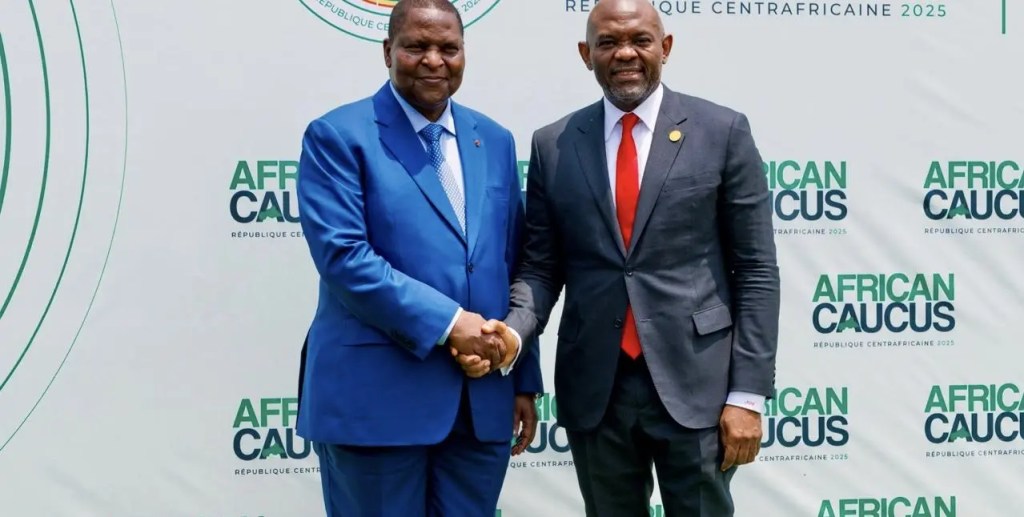
Photo credit: Financial Afrik (central image of UBA establishment in Bangui).
Where We Hit Our Limits
Encouraging signals aside, the Central African private sector as a whole remained on the sidelines. No forum was held to connect investors directly with local entrepreneurs. This includes those in tech startups, agro-processing cooperatives, or the creative industries.
Tony Elumelu’s speech, though strong, did not translate into immediate commitments. He reminded attendees that Africa’s economic future will not be decided solely in institutional meeting rooms. It will be determined in markets, workshops, incubators, and farms. These are the places where value is created daily. Yet, there was no targeted exchange structure to carry his message forward.
A Moment of Visibility Underused
The Caucus could have been a moment for international repositioning for CAR. Yet, beyond a handful of domestic articles and official press releases, no global media strategy was rolled out.
No attempt was made to include Bangui in discussions about cities like Kigali, Accra, or Nairobi. These cities have leveraged such events to brand themselves as business hubs.
Some media outlets seized the moment. CNBC Africa ran in-depth segments on the Caucus’s themes and CAR’s development agenda. Meanwhile, Africa24 delivered exclusive, French-language TV coverage from inside Bangui.
Locally, Centrafrica.com, the country’s largest and most prominent online media platform, along with leading printed press outlets, provided extensive national coverage.
Yet broader platforms are not part of the coverage landscape. These include Jeune Afrique, The Africa Report, Financial Times Africa, and Bloomberg Africa. No in-depth field reporting has surfaced from them. Meanwhile, official government and partner social media accounts stayed surprisingly quiet. Much of the story remained confined to institutional circles. It was not amplified globally.
What It Could Have Been
CAR holds strong cards:
- Natural resources (gold, diamonds, timber) still under-exploited or undervalued.
- Fertile lands suitable for agro-industry.
- A dynamic, connected youth.
- A strategic location in the heart of the continent.
The Caucus could have been the launchpad for:
- Launching an international media campaign positioning Bangui as the gateway to a 50-million-consumer CEMAC market.
- A co-created workshop will bring together public decision-makers, financiers, and entrepreneurs. They will design a 5-year roadmap. This roadmap will cover agro-business, solar energy, tech, and culture.
What’s Next?
Hosting the Caucus was a milestone, but milestones only matter if they lead somewhere. The challenge now is to convert prestige into tangible progress. It is essential to ensure the Central African private sector is at the table next time. They should shape the agenda rather than observe from the sidelines.
The next opportunity must be planned with precision:
- A clear strategy to connect visiting investors with vetted local businesses.
- A media plan positions Bangui as more than just a host city. It establishes Bangui as a credible entry point into the Central African market.
- Concrete follow-up mechanisms so commitments made in the spotlight survive long after the cameras leave.
The world has seen that CAR can host a high-level conversation. Now it must see that we can turn conversations into contracts, and prestige into prosperity. Our past does not define our limits. Our present is the platform from which we leap. Our future belongs to those willing to act boldly and build collectively.


 LISORO MAGAZINE